AI Use Case Study: Clevy
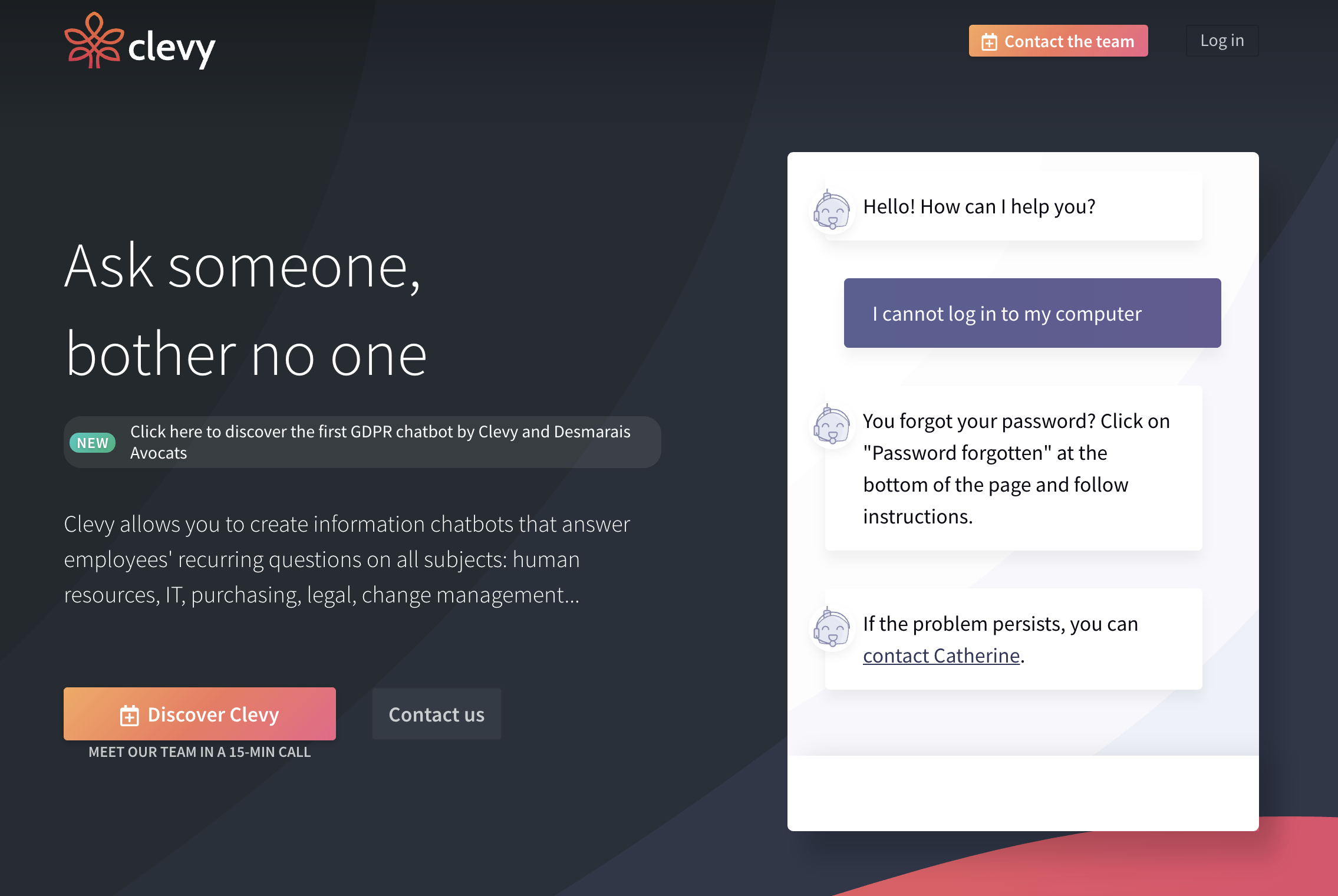
How do we use AI to automate Q and A?
Product
Value Proposition
B2B targeted Chatbot platform for answering repetitive questions from employees (e.g. new staff / handbooks).
Marketed as easier to use than both Amazon’s Alexa Chatbot service and Google’s Dialogflow Chatbot service.
Easier, cheaper, better support, and built to handle business language.
Triggers
- people in businesses don’t have time to learn how to build and maintain a chatbot for their business critical uses.
- even if they do, the solutions in the market now require quite a bit of in-depth knowledge of Natural Language Processing and Conversational Experience to build a non trivial chatbot.
- There is no UI/UX solution in the market targeted at businesses that allow people with no coding experience to maintain chatbots (building is done by the Clevy team).
Market Size
all Business support teams.
Seed Capital
unknown
Target Market
- Human Resources
- IT management
- Purchasing
- Legal
- Change Management
- etc.
AI usage
- Natural Language Processing
- possibly Word / Document Vector Models
Dataset
Type
- Question and Answer pairs
Data Source
- Initial: generated by the client FAQs / Q&A database
- Runtime: enhanced at runtime with dashboard for answering questions, that will update the database
Relevance
- client twitter account handling
- campaign / event based chatbot helpdesk
- service helpdesks
Details
How does it work?
Clevy’s development team builds the first draft, and then they perform beta-testing to get as many questions as they can from real end-users, and at beta-testing time a chatbot UI allows the trainer (not a developer) to enhance the database in real time.
Question Generation
At both creation and runtime, entering a new question and answer pair will trigger a question generation mechanism that generates similar questions to the one being written, so that similar questions map to this answer.
Using the Chatbot
- If a question asked matches the database question exactly, the answer is returned from database.
- If a question is asked that is similar to an answer that has been provided, the system matches the question to the similar database and the answer will be returned.
- if a new question is asked, and no one has answered this question before, the maintainer will be notified and they will type in the answer.
Industry
- Digital Workplace
- Chatbots
- Human Resource Management